Context64.ai
Context infrastructure for engineering teams

Creating the Context Infrastructure for Engineers.

Context64.ai turns fragmented engineering systems into governed context — so engineers and AI can search, reason, and act with traceability.

In production since2022 at major OEMs
Proven upliftUp to 700% productivity (Automotive OEM)
Graph scale~10⁸ nodes · 10⁹ edges
Time to valueFirst context surface in 6 weeks
Context flowlive
PLMTeamcenterCADNX · AnsysERPSAPJIRAticketsREQDOORSTESTqTESTDOCSharePoint
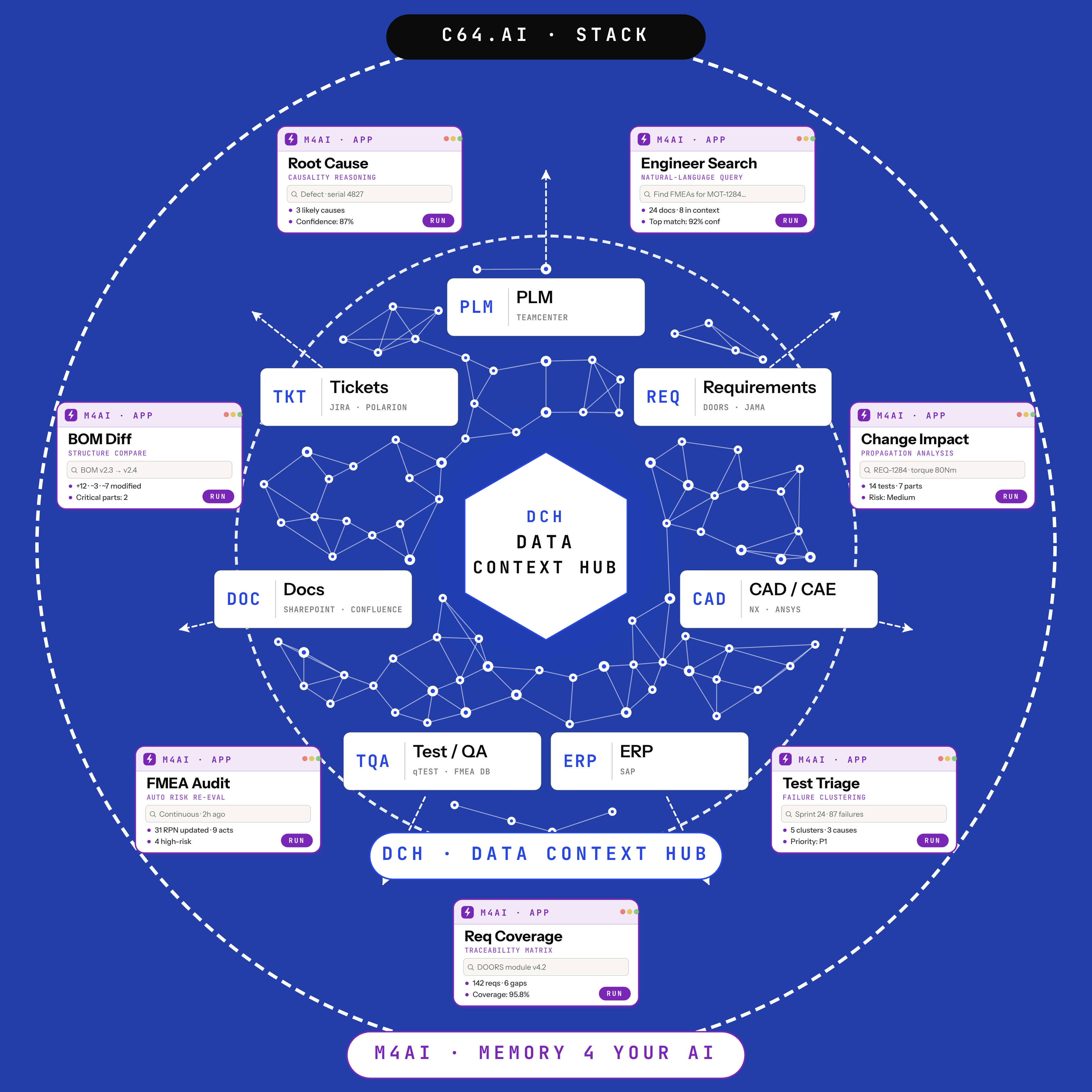
DCHData Context Hubgoverned context graph
M4AIMemory 4 Your AIgraph as agent memory
Root Causelive

Evidence path · graph reasoning

ISSUEBUG-2187 · overheating after firmware update
TEST-9402SPEC-V3Pack Thermal RunawayBattery Module V3
Likely root subsystem: thermal control firmware
traced87% confidence
Trusted by engineering teams & partners
Harley-Davidson logoSiemens logoBMW logoVirtual Vehicle logoNeo4j logoIBM logoEMPOSO logoThreedy logoMicrosoft for Startups Founders Hub logoBMW logoKarlsruhe Institute of Technology (KIT) logoGNS Systems logoVDI Wissensforum logoEBS Universität logo
Why context matters

From scattered engineering data to usable context.

Your knowledge lives across PLM, ERP, CAD, requirements, tests and documents. Context64 turns it into a governed context graph — capturing not just the data, but the relationships, versions, ownership, and evidence that connect it. The result is usable engineering knowledge that engineers and AI systems can search, reason over, and act on — with full traceability.

Engineering sources
RAW · FRAGMENTED
PLMTeamcenter
TicketsJira · Polarion
RequirementsDOORS · Jama
CAD / CAEMechanics · E/E
ERPSAP
Test / QAqTEST · FMEA
DocsSharePoint
Context engine
CONTEXT64AILIVE
C64AI Stack

Connects your systems into governed context and lets AI agents act on it.

DCHData Context HubBuilds governed context — versioned & traceable.
M4AIMemory 4 Your AIDelivers scoped context to agents & apps.GPT · Claude · +local
Governed context
Entities
Relationships
Versions
Evidence
Ownership
Traceability
Application surfaces
Engineering SearchContext searchLIVE“Resclite Pro V3 — tests?”4 src
Change ImpactPropagationLIVE12 reqs · 24 tests hitv3→v4
Req CoverageGaps & coverageLIVE3 open gaps flagged91%
Root CauseEvidence pathLIVEBUG-2187 → Thermal-FW87%
FMEA AuditFailure-mode reviewLIVE3 gaps · evidence linkedaudit
REST APIMCPEmbedded UIDashboardsCustom Apps
One context layer. Many engineering surfaces.
Scattered dataContext engineUsable context
Company BrainLLM-sovereign by design

Your context becomes a durable company brain — portable across any model, no lock-in.

80%More AI accuracy

Governed, graph-scoped context instead of vague retrieval over document dumps.

Up to 87%Fewer tokens

Exactly tailored context per task — consistent quality at a fraction of the operational cost.

03 — The stack

One platform. Two engines. Many surfaces.

Intake → DCH → M4AI → Delivery — with C64 Studio as the workbench across the stack. DCH builds context, M4AI reasons over it, Studio helps build the applications and workflows that expose it wherever engineering work happens.

01Intake Layer

Connect any engineering source

Connect the systems, repositories, and workflows where engineering work already happens — PLM, CAD, requirements, tests, tickets, and documents.

ConnectorsIntake agentsWorkers
Explore Intake Layer
IntakeDCHM4AIDelivery

Application workbench for creating tools, workflows, and engineering surfaces across the stack.

Data-ForgeKnowledge-ForgeTool-ForgeAgent-ForgeApp-Forge
Explore C64 Studio
04 — Application surfaces

Build any engineering application on the Context Layer.

Use what we’ve prebuilt. Or compose your own using REST API, MCP, Studio Apps and embedded tools— all on the same Context Graph.

In practice

Battery Module V3 requirement update

A single requirement change can affect specifications, tests, FMEA logic, CAD assemblies, release gates, and downstream variants.

InputsRequirement revision, spec update, part change
Context64 tracesAffected tests, FMEA entries, CAD assemblies, release gates, and variant dependencies
OutputA full impact view before approval
Business valueFaster engineering decisions with fewer downstream surprises
RequirementsSpecsTestsFMEACADRelease GatesVariants
In practice

Audit readiness before release

Engineering teams verify whether each requirement is connected to specifications, tests, and release evidence.

InputsRequirements, specs, test evidence, release artifacts
Context64 checksCoverage gaps, missing evidence, stale links, incomplete traceability
OutputA clear view of what is covered and what is missing
Business valueCatch gaps before audits and reduce manual evidence chasing
RequirementsCoverageEvidenceAuditTraceability
In practice

Field issue traced to subsystem

A bug ticket is traced across engineering evidence to identify the most likely responsible subsystem.

InputsTicket, test result, requirement links, revision history
Context64 followsEvidence paths across specs, components, tests, and design changes
OutputLikely root subsystem with supporting artifacts
Business valueReduce investigation time and improve confidence in corrective action
TicketsEvidence PathTestsRevisionsRoot Cause
In practice

Failure pattern checked against live FMEA

New failure information is compared against the current FMEA to reveal gaps, outdated assumptions, and missing controls.

InputsFailure data, requirements, design changes, FMEA records
Context64 validatesFailure modes, controls, linked requirements, design consistency
OutputContinuously updated FMEA insight
Business valueKeep risk models aligned with real engineering changes
FMEAFailure DataControlsRequirementsRisk
In practice

SysML architecture drift detection

Context64 identifies where architecture, requirements, and downstream engineering artifacts have drifted out of sync.

InputsSysML models, requirements, validation assets, downstream artifacts
Context64 alignsModel elements, trace links, implementation references, validation coverage
OutputA targeted sync view of what needs updating
Business valuePrevent silent drift between architecture and implementation
SysMLMBSERequirementsValidationDrift Detection
In practice

Variant-specific change assessment

A change is evaluated across product variants, markets, and production configurations to show exactly what is affected.

InputsComponent update, configuration tree, market/variant structure
Context64 reasons overVariant dependencies, downstream impact, configuration relationships
OutputPrecise insight into affected and unaffected variants
Business valueAvoid over-scoping change decisions and reduce variant complexity risk
VariantsConfigurationMarketsProduction LineImpact

Build Your Own

Or let us build it with you.

Have a workflow that doesn’t fit a template? Compose it with Studio Apps, MCP and REST APIs — or partner with us to ship it.

Talk to engineering
05 — Proof

Built with teams working on complex products.

Co-developed and deployed with OEMs, suppliers, research organizations, and technology partners across engineering-heavy environments.

Automotive · 5 min read

German OEM builds a linked data layer for engineering systems

A linked data layer unified engineering knowledge across systems into a single contextual fabric, with a Knowledge Graph at the core.

Read case study
Technology Partner · 5 min read

Making engineering data lakes usable with IBM

IBM and Context64 turn massive engineering data lakes — vehicles, manufacturing, simulations — into usable governed context.

Read case study
Automotive · 5 min read

AI-driven test generation for automotive engineering

With Emposo, Context64 implemented TestForge — generating test cases directly from complex engineering inputs.

Read case study
Research Partner · 5 min read

Virtual Vehicle: an AI knowledge hub for engineering

Europe’s largest virtual-vehicle R&D centre and the origin of Context64’s core knowledge graph work.

Read case study
DCH

Data Context Hub

Connects engineering data, models the ontology, builds the context graph, and delivers precise, governed context on demand.

OntologyContext graphRetrievalVersioningGovernance
Explore the Data Context Hub
M4AI

Memory 4 Your AI

Build no-code agent systems on top of the DCH knowledge graph — the graph is their memory, scoped and governed.

No-code builderGraph memoryMulti-agentEmbeddableAny LLM
Explore Memory 4 Your AI
06 — In their words

Trusted by people building engineering AI.

Implementation Partner
The context problem of today’s LLMs is not a usage error — it is a systemic problem. Context64 does not solve it with ever-larger models, more tokens, and more agents, but the other way around: through precise control of the context the models work with. Instead of letting the model puzzle over a vague, enormous context, the platform delivers exactly tailored context for every task. The result: consistent quality at a fraction of the operational cost.
Roman BretzCTO · Emposo
Customer
From a single part selection in the PDM system, Context64 pulls the full engineering chain across Teamcenter, DOORS, JIRA and SAP — down to the line in all production facilities.
Engineering leadershipGerman Automotive OEM
Research Partner
Decades of research only create value when engineers can find and apply them. With Context64, our project knowledge becomes a living graph that researchers and vehicle programs can actually query.
Research leadershipVirtual Vehicle Research GmbH
Consulting Partner
Together with Context64.ai, we bring AI to where it truly matters: into the daily work of development organizations. Less PowerPoint, more measurable impact — faster, scalable, and sustainable.
Dr. Stefan WenzelManaging Director · 3DSE Management Consultants
08 — FAQ

Questions teams ask before building on context.

A context graph connects engineering entities, relationships, versions, ownership, evidence, and dependencies across systems — modeling how engineering work actually relates: requirements to tests, components to changes, failures to mitigations.

RAG retrieves fragments. Context64.ai builds a governed context layer — agents and applications reason over entities, relationships, lineage, permissions, versions, and evidence, not only text chunks.

Data Context Hub builds and governs the context layer. Memory 4 Your AI uses that graph as memory for agent systems, letting teams build agents that reason over governed engineering context.

No. Context64.ai sits above existing systems and turns their data into a connected context layer. Teams keep using their current PLM, CAD, ALM, ERP, ticketing, document, and test systems.

Yes. It supports cloud, private cloud, on-prem, and controlled deployment models — including EU-sovereign and air-gapped variants where required.

Research it yourself

Let AI assess your engineering context strategy.

Ask your assistant of choice how Context64.ai turns fragmented engineering systems into a governed context layer — connected, versioned, and traceable across design, engineering, production, and service organizations.